
YOUR AUTOTRADER INVESTMENT IS WORKING HARDER THAN YOU THINK
When you evaluate Autotrader, Kelley Blue Book, and Car and Driver performance beyond lead counts, the marketplace’s real impact becomes clear. More buyers are already in your pipeline — you just can’t see them yet.

Car shopping has changed. Measurement should too.
The way buyers shop has fundamentally changed — but most dealers are still measuring success the same way they did a decade ago. If you’re only counting leads, you’re only seeing a fraction of what’s really driving your sales.
Days the average buyer spends in market
Digital touchpoints buyers engage with
Shoppers interacted with a third-party site in the buyer journey
of car shoppers start their journey on a third-party marketplace
of Autotrader-assisted sales never appear in your CRM.
Out of 875,000 shoppers studied, most buyers never filled out a form, made a call, or started a chat. But they still bought a car. No wonder ROI can sometimes feel like a guessing game.
Your CRM is only showing you
2 OUT OF 62 TOUCHPOINTS
in the average buyer’s journey.
That’s not a glitch — it’s a blind spot. And it’s costing dealers real revenue.
Why lead-based reporting misses Autotrader’s real influence
In-market shoppers research deeply on Autotrader — often without ever becoming a lead. When you look at where buyer journeys actually start, 48% begin on a marketplace like Autotrader, compared to just 14% that start on a dealer’s own site.
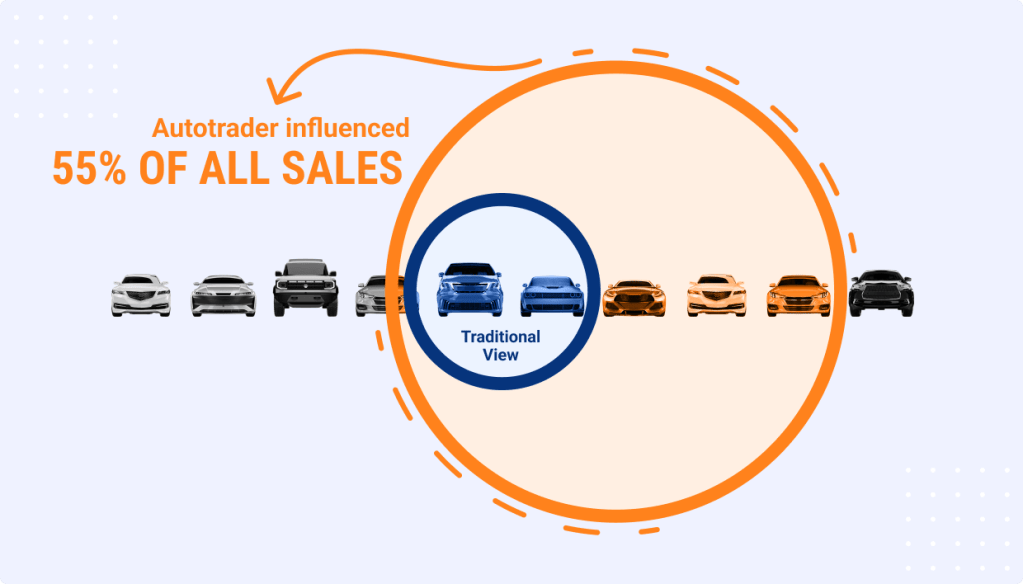
Multi-touch attribution is the key to understanding the full buyer journey.
Rather than crediting only the last touchpoint before a sale, multi-touch attribution assigns value to every meaningful digital interaction — giving you a true picture of what’s actually driving your sales and where Autotrader fits in.
What you can do to start measuring real value:
-
General Manager /Owner
Autotrader influences buying decisions long before a sale occurs, but without multi-touch attribution that impact is often undercounted in ROI and budget decisions.
-
Sales Manager
Multi-touch attribution reveals which touchpoints actually move buyers toward a decision — giving your team real insight into what’s working beyond the lead form.
-
Internet Sales Manager
Validate performance beyond lead volume and better understand how digital engagement supports showroom traffic—even when no form fill happens.


By evaluating shopper behaviors based on true likelihood to convert — not just counting leads.
The walk-in isn’t the first touch — it’s the 62nd
Website links are as valuable as leads in your CRM
Include chats, return visits, and browsing depth as meaningful demand signals
Leads ≠ Buyers.
Every shopper action has value — not just the ones that generate a form submission. When you measure what actually matters, the picture changes dramatically.

Clairvoy 2024 sales data: Clairvoy is a marketing technology firm in the automotive industry. They collected and analyzed anonymous buyer data from 1,181,705 sales in 2024.
Cox Automotive Car Buyer Journey Study: In 2024, Cox Automotive surveyed roughly 2,300 people who purchased or leased a vehicle between September 2023 and August 2024 and used the internet as part of their buying experience.
FAQs
Most buyers do not submit a trackable lead before purchasing. They may view inventory, compare vehicles, click to your website or visit the store without ever completing a form, call or chat that shows up in your CRM.
Proof point: In the Autotrader attribution analysis, 92% of Autotrader-assisted sales never appeared as CRM leads. In 2024, 1 in 3 car sales happened without a lead conversion.
Key takeaway: If you use lead data alone, you are only seeing a small part of Autotrader’s actual influence.
Multi-touch attribution gives credit to the meaningful steps a buyer takes before purchase, not just the final click or lead form. It helps show which channels influenced the sale across the full shopping journey.
Key benefits:
- Captures more of the full buyer journey
- Shows real marketing impact beyond lead forms
- Helps support better budget decisions
Proof point: Under multi-touch attribution, Autotrader influenced 55% of sales compared to 21% under last-touch attribution.
Key takeaway: MTA helps you see what influenced the sale, not just what captured the lead.
The average buyer interacts with 62+ digital touchpoints before purchasing. Your CRM usually captures only a small part of that activity.
Proof point: The average car buyer spends 95 days in market and engages with 62+ digital touchpoints across 4 channels before purchase.
Implication: If your CRM only shows the final lead, it does not show the full path that helped create the buyer.
Many shoppers begin by researching across marketplaces, search engines and dealer websites. Marketplaces like Autotrader play an important role in early discovery because shoppers use them to compare vehicles, pricing and availability.
Proof point: 48% of shoppers start on marketplaces, compared to 23% on search engines and 14% on dealer websites.
Implication: Marketplaces are a key discovery channel, not just a place for last-click leads.
Lead-based reporting only shows shoppers who raised their hand in a trackable way. It misses many of the research and comparison steps that happen before a shopper submits a lead, visits the store or buys.
Problem:
- Shows only a small portion of the buyer journey
- Misses pre-purchase research and repeat activity
- Can undervalue channels that help create demand
Proof point: Dealers typically see only about 2 of 62+ digital touchpoints in CRM data.
Result: Lead-only reporting can make high-influence channels look less valuable than they really are.
Autotrader influences shoppers while they are discovering vehicles, comparing options, reviewing pricing and deciding where to buy. Those actions can move a shopper closer to purchase even if they never submit a form.
Autotrader influences buyers through:
- Listing views
- Price comparisons
- Website click-throughs
- Repeat visits
Proof point: Autotrader influenced 55% of sales when multi-touch attribution was applied.
Key takeaway: Autotrader helps drive buyer interest and sales influence beyond the lead form.
Cost per lead can still be useful, but it should not be the only way you judge performance. Dealers should also look at the signals that show buyer quality and sales influence.
Examples:
- Website clicks from listings
- Multi-touch attributed sales
- Return visits and browsing activity
- Calls, walk-ins and other high-intent actions
Proof point: Weighted engagement helps compare shopper actions based on buying intent. For example, a walk-in may be worth about 3x a lead form, while chat may be worth about 0.33x.
Focus: Focus on ROI and buyer quality, not just lead volume.
The average buyer journey lasts 95 days. That means a lot of research and comparison happens before a lead is ever submitted.
Proof point: The average car buyer spends 95 days in market, with 62+ digital touchpoints across 4 channels.
Implication: Most of the journey happens before the final lead, so last-touch reporting can miss the influence that helped drive the sale.
The CRM blind spot is the buyer activity that helps influence a sale but never appears as a trackable CRM lead. This can include listing engagement, repeat visits, pricing research and website clicks.
Impact:
- A large share of buyer activity can be invisible
- Key channels may be undervalued
- Budget decisions may be based on incomplete data
Proof point: 92% of Autotrader-assisted sales never appear in CRM systems, and dealers typically see only about 2 of 62+ buyer touchpoints in CRM data.
Key takeaway: Your CRM is important, but it does not show the whole story.
Dealers should look at actions that show shopper interest and intent, not just completed lead forms.
Key demand signals:
- Website link clicks
- Return visits
- Browsing depth
- Chat interactions
- Calls and walk-ins
Proof point: The Weighted Engagement Formula normalizes shopper activity into one ROI-focused metric, helping compare different actions by value.
Best practice: Use these signals in a weighted engagement framework tied to sales potential.
READY TO SEE YOUR REAL ROI?
Ask your Autotrader rep how attribution thinking reveals the full impact of your marketplace investment.
Required form fields